
Technological Progress Is Not Linear
What we can learn from Horses on the Battlefield

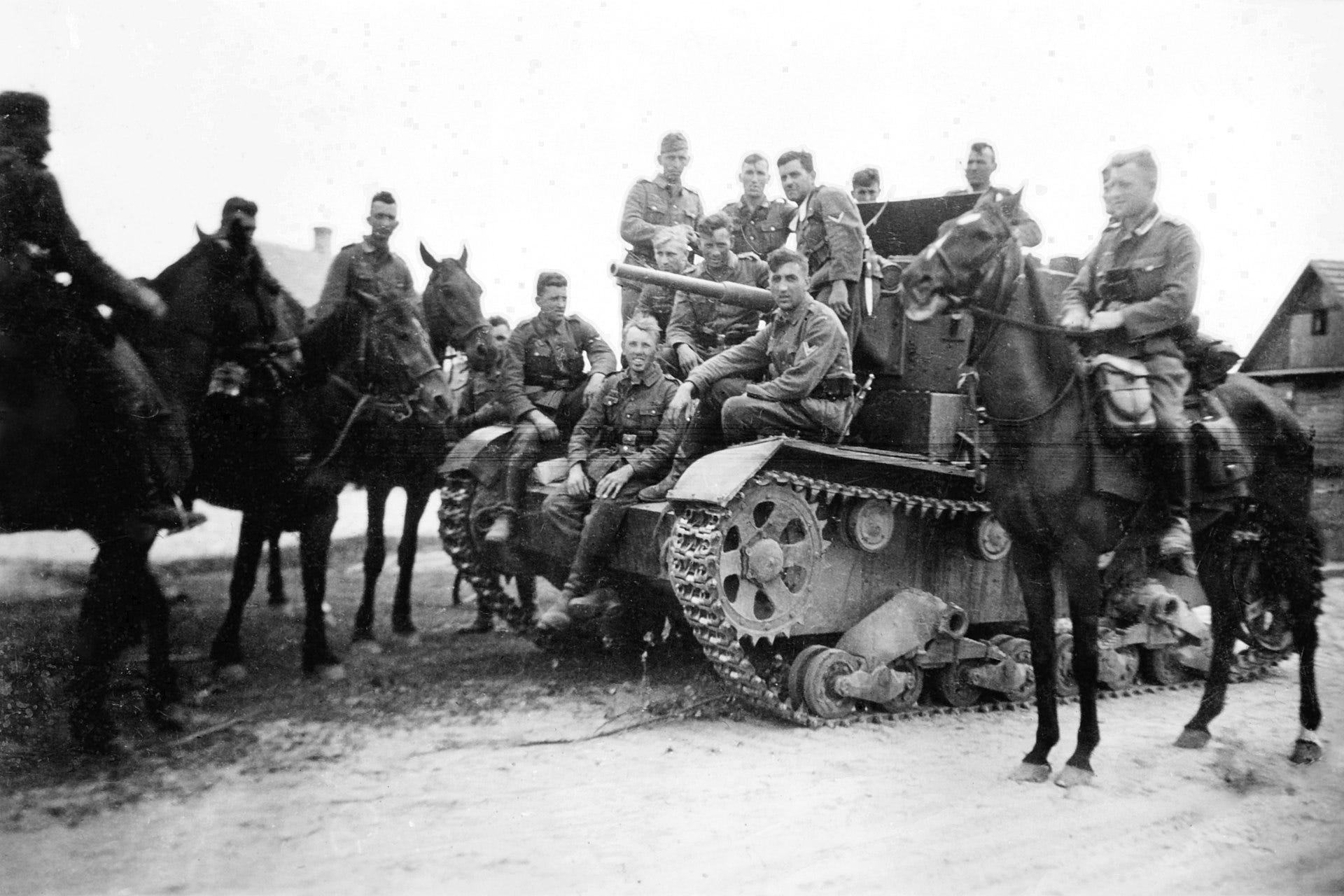
The horse has long been a staple of military technology. From Egyptian Chariots to Parthian Cataphracts, to French Gendarmes and Polish Winged Hussars, it is easy to imagine that the horse has always been the ancient equivalent of a modern tank.
The story of the horse is more complicated, however. At several points throughout history, it seemed like the time of the horse had become obsolete due to technology. How it continued to keep coming back provides a lesson in innovation, and why “progress” is seldom linear.
The Military Arms Race
"A dense and well-compacted phalanx cannot be broken or beaten by cavalry, however numerous or bold."
- Polybius, Histories, 2nd Century BCE
Warfare has always been driver of technological progress. Few areas of human capability have changed as dramatically as the ability to inflict destruction on one another. Tribes, nations and empires have always competed for power, and war is the most direct manifestation of that competition. There is a strong incentive for military innovation, as superior technology or tactics can lead to visible advantage over an enemy.
Economics and military technology have often been intertwined. The dominant military technology of the Bronze Age was the chariot. This was an era of inequality, where ‘God-King’ emperors could defeat numerically superior forces through their chariots. An elite ruling class with access to horses and chariots could quite easily dominate armies far larger.
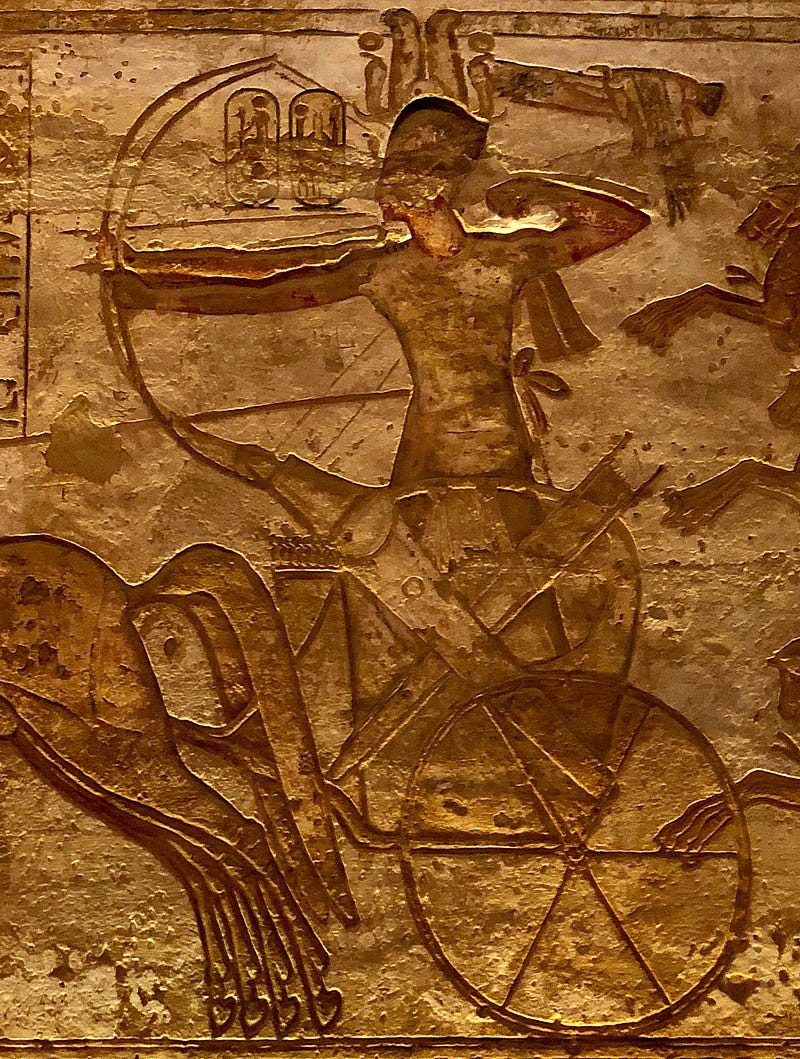
Horses have always been expensive, meaning those with wealth typically had greater access to them. Periods in military history when the horse had the greatest advantage were usually those dominated by a few powerful elites. When the technology of the time allows the few to dominate the many, then warfare is generally more muted - fighting was often between elites.
Total war, on the other hand, emerges when the balance of technology shifts in the other direction - when technology permits entire societies to mobilise to become a potential militia.
The first of these was the transition from the Bronze Age to the Iron Age. This period saw the triumph of the phalanx (a tight group of soldiers with spears) begin to challenge the chariot. The Greeks and Macedonians in particular were able to use long spears to end the dominance of horses and chariots. Spears had an advantage - they were cheap and required little skill, meaning large numbers could militarily compete with the horse.
The phalanx, however, was eclipsed by combined arms of the Roman legions. In the next evolution of military technology, manoeuvrability was able to defeat the less flexible phalanx. The rise of Rome was still an era of infantry, with the horse a more supporting role.
However, as Rome fell, advances in steel technology meant that nobility once again began to have an advantage. Give a knight a suit of steel armour and a horse, and those who could not afford steel would struggle to compete. The spreads of stirrups to Europe in the 6th to 8th Centuries hastened the evolution. This created the era of feudalism, when armoured nobility ruled over serfs and peasantry. The knight on horseback would dominate warfare in early Medieval Europe. It was more advantageous to invest very heavily in a small number of elite knights in this period, as a few knights could sway a battle.
The Fall of the Knight
"The day of the horse is past, and now is the time of the footman, armed with his musket and pike."
- Sir John Smythe, English military writer, 1590
The advantage of military technology comes from asymmetry. If one can inflict damage on an enemy without being hurt oneself, then, in the long run, they will have the advantage. At some points in history, military technology favoured the defender - consider a medieval castle. Attackers would have to employ a long and costly siege before attempting to storm the ramparts.
However, with the invention of the cannon, castle walls were not longer impregnable. Even the Walls of Constantinople, at 15ft thick were eventually brought down by cannon fire. The Thirty Years’ War was marked by many long sieges, as more powerful cannons battered larger and larger defensive forts. Eventually, artillery became more powerful than the strongest wall.
At different periods in history, military technology has favoured both the attacker and the defender. The horse has typically been a technology of the attacker. Its speed and weight gave it the advantage for ‘shock tactics’, a thundering charge aimed to break opposing infantry.
The armoured knight on horseback was the medieval equivalent of a tank. For hundreds of years, it had been the dominant force on the battlefield, wielded most notably by the French within Europe.
The arrival of gunpowder changed European battlefields forever. From the 14th and 15th Centuries, arquebuses (short-range guns), muskets and cannon began to appear. The rise of ‘pike-and-shot’ warfare marked a new kind of warfare, strongly favouring defensive tactics. This involved infantry with firearms, guarded by pikes, and supported by cannon fire. As military technology improved even the most heavily armoured knights were vulnerable to musket shots and pikes.
Both muskets and pikes requires relatively little skill and could be mass produced, and so nations began to favour large armies of infantry. Melee cavalry began to disappear from European battlefields.
Horses still existed on the battlefield, and their role was integrated with gunpowder weapons. Horsemen would carry a revolver and unload shots into enemy ranks, whilst still having the manoeuvrability of horses to escape pikes, known as the caracole. As infantry became easier to arm with firearms, cavalry retreated into a reconnaissance role. The cost of maintaining heavy cavalry was not worth the payoff on the battlefields.
Technology, it seemed, had made the horse obsolete on the battlefield. Like how the phalanx had displaced the chariot, the musket had now broken the knight.
The Horse Comes Galloping Back
“Flashed all their sabres bare,
Flashed as they turned in air
Sabring the gunners there,
Charging an army, while
All the world wondered.
Plunged in the battery-smoke
Right through the line they broke;
Cossack and Russian
Reeled from the sabre stroke
Shattered and sundered.
Then they rode back, but not
Not the six hundred.”
- Alfred, Lord Tennyson, Poet Laureate, “The Charge of the Light Brigade”, 1854
In 1590, Smythe had predicted the demise of the horse. Just forty years later, however, the horse would make a return, and remain on the battlefield for another three hundred years.
In the Thirty Years’ War (1618 to 1648), a Swedish King named Gustavus Adolphus brought back shock cavalry. He recognised that using pistols from horseback was inferior to infantry fire, and the lack of decisive charges allowed enemy infantry to retreat and regroup.
He re-implemented cavalry charges with swords or lances, charging after a pistol volley in a tight and deep formation. Whilst horses were not bulletproof, a disciplined charge from horsemen into infantry with primitive muskets still proved devastating.
"The Swedish horse do not use the caracole, as is the practice of other nations, but ride up close to the enemy and fall in with sword in hand, trusting to the vigour of their charge and the weight of their horses to break the enemy's ranks." - (‘Monro, His Expedition with the Worthy Scots Regiment (Called MacKeyes Regiment)’, 1637)
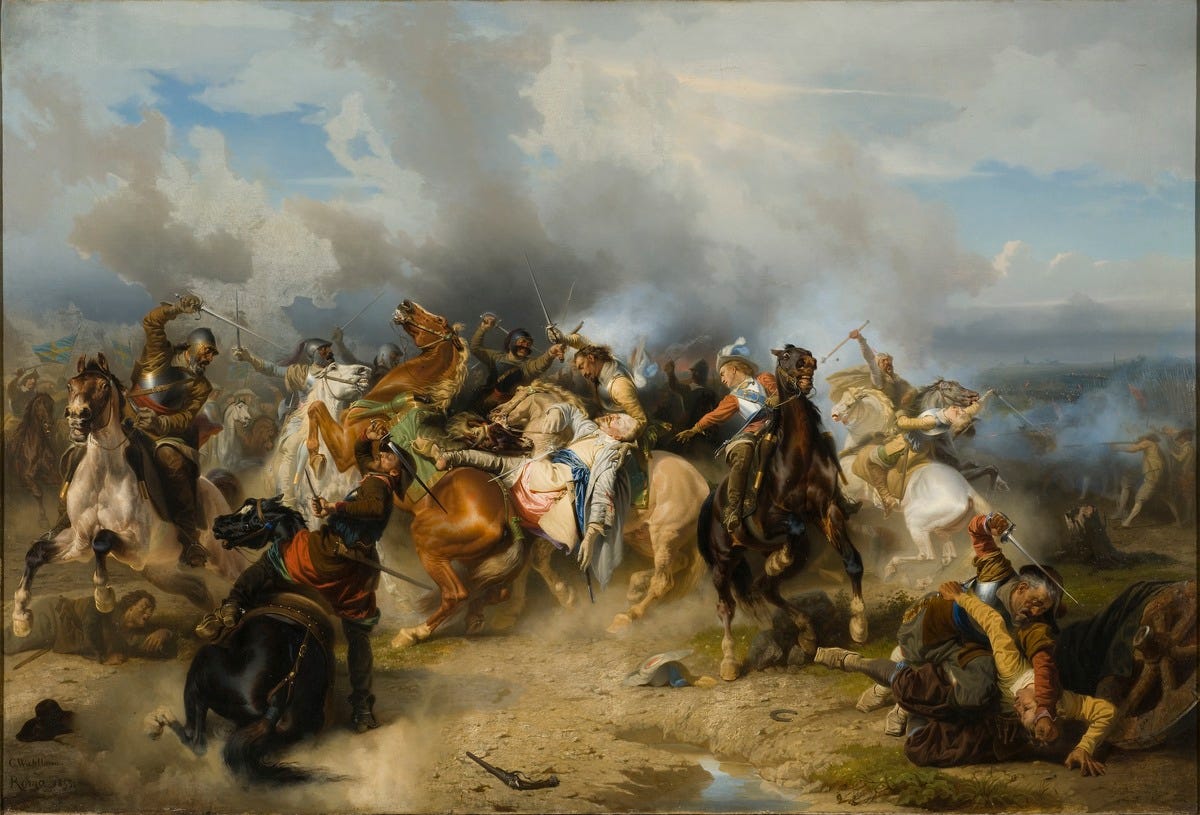
Gustavus himself led the charge at the Battle of Lutzen in 1632, one of the last European Kings to die in combat. Despite his death, his tactics lived on. Melee cavalry continued to be a mainstay of professional armies, alongside infantry and cannon.
In 1683, fifty years later, the shift in horse warfare was exemplified at the Siege of Vienna. The Ottoman Empire sieged the Austrian capital with over three hundred thousand troops, their furthest advance into Europe. A relief force sent by the Polish was led by 18,000 horseman, who charged down the hill to relieve the city. At the tip were three thousand Polish lancers. The charge, which inspired the Ride of the Rohirrim in Lord of the Rings, turned the tide of the battle and the entire war. The horse was once more a master of the battlefield.
The horse’s manoeuvrability and speed remained unmatched for hundreds of years, through the Seven Years’ War, the Napoleonic Wars and the Crimean War.
Creative Destruction - when technology became too strong
“The day of the horse is over. The tank represents the future of modern warfare.” - Heinz Guderian, German General, 1937
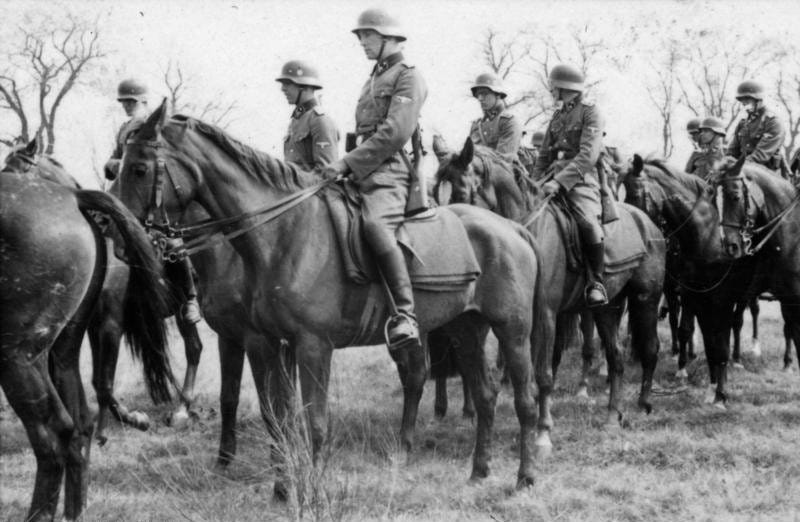


The First World War marked the beginning of the end for the horse. By this point, Military technology had advanced to favour the defender. Machine guns, barbed wire and trench warfare nullified the advantage of the horse on the Western front. Their role gradually shifted to a logistical one.
However, the true death of the horse came from its competition - the tank. The tank (initially called the land-ship) first appeared primitively in the First World War, but by the Second World War replaced the role of the horseman.
The Battle of Krasnobród took place on 23 September 1939, seeing one of the last cavalry clashes in European history, when German and Polish horseman fought one another. The German army retained horse divisions on the Eastern front, when forested or swampy terrain was impassable by tank, however, tank technology had reached a point where the horse could not compete.
To this day, tank regiments are still referred to as ‘cavalry’, fulfilling the same role as the ancient horse. What a chariot was to Bronze Age battlefields, a tank was in modern warfare.
Technological progress is often seen as linear - with the next technology automatically superior to the one that came beforehand. Military technology shows that this is not necessarily the case: what matters is how that technology is used.
Throughout all of history, warfare has fluctuated depending on the technology of the time. Chariots dominated the Bronze Age until armoured cavalry came along. Heavy cavalry was defeated by the Greek Phalanx, who were in turn defeated by more combined-arms Roman legionnaires. The Romans legions struggled to defeat the heavy cavalry of Nomadic peoples such as the Huns. Heavy cavalry dominated the early medieval era through the knight, but were defeated by longbows, crossbows and pikes.
When gunpowder was invented, it took centuries to become completely dominant. The horse alternated between dominating the battlefield and taking a supplementary role. With a linear view of progress, one would not predict the return of the horse - it would be akin to predicting the return of modern-day fax machines.
War is a form of competition. There is a single objective - victory, and technological advances will be used if they provide an advantage over existing technologies. ‘Progress’, in this case, means more effectively achieving victory. The incentives are aligned towards progress in military technology, and have been as long as nations have fought. Creative destruction, often referred to in economics as the displacement of firms who are inefficient in competitive markets, here applies to the nations that cannot compete military with their peers.
Technological progress is not inevitable
One might expect that in a purely competitive world, military technology might continue to advance forever. However, recent history shows where cooperation prevented a never-ending arms race.
Exceptions to creative destruction include agreements to avoid certain types of weaponry, such as nuclear, chemical or biological. In these cases, further technological progress was deemed undesirable for humanity, and there remains broad consensus that non-proliferation of these weapons are good.
According to legend, non-proliferation almost happened with the machine gun in 1718, when the French King Louis XV thought that it would make warfare far too destructive.
“According to legend, James Puckle demonstrated his innovative Puckle Gun—a flintlock repeating firearm capable of firing multiple shots without reloading—to the French king, the monarch was so alarmed by its potential to revolutionize warfare that he offered Puckle a substantial sum of money to destroy the invention and keep it from being used in battle. Puckle, a patriot, refused the offer and instead sought to present his weapon to the British military.”
Alas, this tale is likely false. The Puckle Gun, despite its ingenuity, was ultimately rejected due to its unreliability and the technological limitations of the era, leaving the tale of the French king's attempt to suppress it as a fascinating story of what might have been. It foreshadowed the invention of the Gatling Gun in the 19th Century.
Competition spurs innovation in incumbents as well as new technologies. The invention of iron ships caused immense technological progress in wooden ships over the 19th Century, with competition causing wooden ships to reach their technological peak. Iron ships proved victorious in the long-run, but in the early 1800s, it was by no means certain they would eventually become dominant.
What can we learn from the horse?
The horse provides an example that just because technological competition exists, it does not automatically displace its competitor. This applies to market-based competition as well as military.
There are many areas where new technologies have not replaced those they expected to displace. Books and print media have been remarkably resilient to the rise of new media, whereas stone tablets have disappeared. The radio, and now podcasts, have continued to remain a staple despite competition from television.
When television was invented, it was suspected that the average American family simply would not have time to watch television. We see similar debates raging at the moment from the legacy media when news increasingly comes from independent podcasters and social media.
In the early 2000s, there was a belief that 3D television was the next big thing - that has not happened yet, with many cinemas reverting from 3D to higher quality 2D films. Predicting future trends is notoriously difficult, hence the immense rewards captured by entrepreneurs and investors who do so successfully.
The idea that progress is always obvious and moves in one direction ignores thousands of years of cyclical progress - creative destruction inevitably creates periods of competition when we are not sure which technology is better. Consider the rise of electric vehicles - it is still uncertain whether they will displace a diesel engine.
Let the repeated defiance of the horse on the battlefield serve as an inspirational tale - even if technology may be moving in one direction, creativity in how old technologies are used can certainly affect its march, like how Gustavus Adolphus brought back cavalry. And sometimes, it takes a bit of competition to inspire making the most out of the technology we already have.
Leave a comment of any examples where incumbents successfully innovated to face off competition. Especially, leave examples if you know of any recent battles that the horse has played a major combat role in.
Really excellent article! I enjoyed this a lot!
Another great article